How to Report Carbon Emissions as a Supplier: An Eight-Step Guide for UK Businesses
A customer has asked for your emissions: the formats they use, the eight steps to answer, how to allocate a share and the mistakes to avoid.
 Andrew WoodwardCo-founder & Managing Director 20 min read
On this page
A customer has asked for your carbon emissions. The request might be an invitation to disclose through CDP, a supplier sustainability questionnaire, a Carbon Reduction Plan clause in a public tender, or a spreadsheet from a procurement team that needs a number by Friday. Whatever the format, the logic behind it is the same: the emissions from making and delivering what you sell are part of your customer's scope 3, and without your figures they are left estimating.
This guide explains how to report carbon emissions as a supplier, step by step: what customers actually ask for and why, the eight stages from reading the request to submitting the answer, how to allocate a share of your footprint to one customer when asked, and the mistakes that weaken a submission. It is written for the business on the receiving end, with the rules as they stand in November 2026, the EU's new supplier cap included.
Quick answer: how do you report carbon emissions as a supplier?
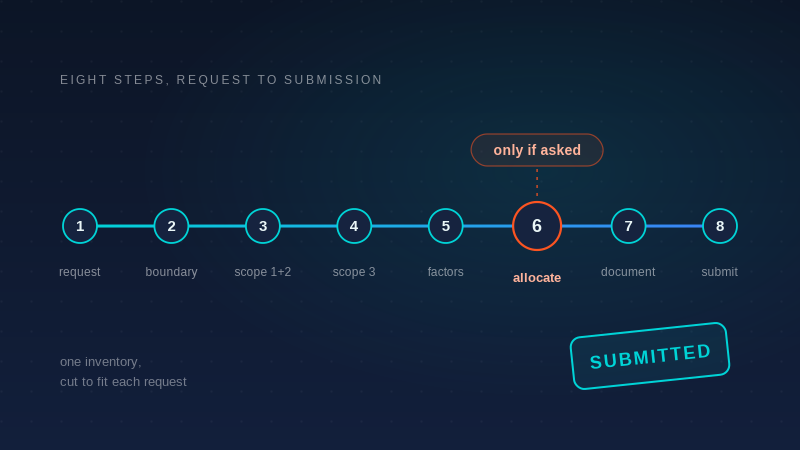
Work out which format the customer needs, set your organisational boundary, calculate scope 1 and 2 from your fuel and energy records, add the scope 3 categories the request names, convert the activity data with the UK Government's conversion factors, allocate a share to the customer only if asked, document your method, base year and data quality, then submit in the customer's format.
Key takeaways
- Customers ask because part of their scope 3 is made of your emissions. 45,000+ suppliers were asked to disclose through CDP in 2025.
- CDP, PPN 006, UK SRS S2 and the EU's voluntary standard all build on the GHG Protocol, so one well-documented inventory answers all of them.
- Scope 1 and 2 from your own meters, bills and fuel records are the core of almost every request. Scope 3 is added category by category, and the request usually names which.
- If a customer wants its share of your footprint, the GHG Protocol Scope 3 Standard sets the method: avoid allocation where product-level data exists, otherwise allocate by a physical or economic factor, disclose it, and keep customer shares summing to 100%.
- For financial years beginning on or after 1 January 2027, a customer reporting under the EU's CSRD cannot require more from a supplier with up to 1,000 employees than the Commission's cap list: on emissions, scope 1 and location-based scope 2.
Why is your customer asking for your emissions?
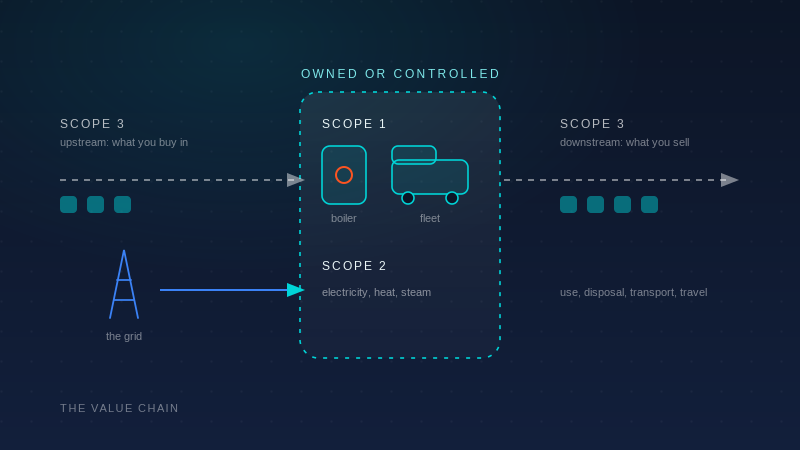
Because your emissions are a line in their report. What you burn, buy and ship to deliver their order lands in their scope 3 under the GHG Protocol's Scope 3 Standard: mostly in category 1, purchased goods and services, with the delivery leg in category 4, upstream transportation and distribution. If the scopes are new to you, start with our explainer on scope 1, 2 and 3 emissions.
The scale explains the pressure. CDP's technical note on scope 3 relevance, analysing its questionnaire responses, found that "across all sectors Scope 3 emissions account on average for 75% of total Scope 1+2+3 emissions in the sample". A CDP and BCG analysis of 2023 disclosures put supply chain emissions "on average, 26 times greater than their emissions from direct operations".
The questionnaire on your desk is the GHG Protocol working as designed. The Scope 3 Standard tells reporting companies they "may send questionnaires to each relevant supplier or other value chain partner" asking for "Scope 1 and scope 2 emissions data" for "the reporting year", for "The supplier’s upstream scope 3 emissions" and for "Whether the data has been assured/verified, and if so, the type of assurance achieved". It also requires them to publish "the percentage of emissions calculated using data obtained from suppliers or other value chain partners", so a customer has a standing reason to replace a spend-based estimate of you with your real figures.
What do customers actually ask for, and in what format?
A UK supplier can expect a request in one of six forms. The four with a published standard behind them all build on the GHG Protocol, so one inventory can be cut to fit each.
| Request format | Who sends it | What it asks for | Standard behind it |
|---|---|---|---|
| CDP supply chain disclosure request | A customer that is a CDP Supply Chain Member | CDP's main questionnaire, or the version built for SMEs, plus supply chain questions relevant to that customer, whose answers feed its scope 3 accounting | CDP's own questionnaire; its scope 3 guidance follows the GHG Protocol's categories |
| Sustainability ratings platform (EcoVadis and similar) | Customers running supplier assessment programmes | An analyst-verified scorecard across four themes: environment, labour and human rights, ethics and sustainable procurement. Environment is one of the four, so a carbon figure is not the whole assessment | The platform's own methodology |
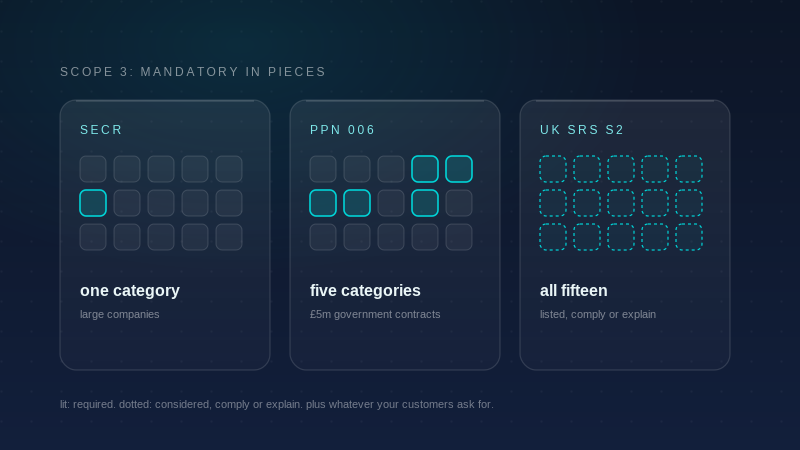
| PPN 006 Carbon Reduction Plan | Central government departments, executive agencies and non-departmental public bodies, for contracts above £5 million a year including VAT | Scope 1, scope 2 and five named scope 3 categories for a reporting year, a baseline year, reduction targets and a signed declaration, published on your UK website | GHG Protocol Corporate Standard; UK Government conversion factors |
| Data request from a UK SRS S2 reporter | Listed companies, for accounting periods starting on or after 1 January 2027 under FCA PS26/19, and voluntary adopters | Whatever lets the reporter replace estimates with primary data, such as supplier-specific emission factors for what it buys from you | UK SRS S2, measured under the GHG Protocol |
| Data request from an EU CSRD reporter | Companies in scope of the CSRD: above 1,000 employees and €450 million net turnover | From a supplier with up to 1,000 employees, no more than the Commission's cap list. On emissions that is scope 1 and location-based scope 2 | Directive (EU) 2026/470; Delegated Regulation (EU) 2026/1560 |
| Bespoke spreadsheet or contract clause | Any customer | Varies: total tCO2e, an intensity per pound or per unit, or a share allocated to the contract | Whatever the request cites. Ask if it does not say |
CDP's Supply Chain Membership page describes the mechanism: a supplier answers the main questionnaire plus questions relevant to the customer that asked, and members "then incorporate this primary data into their own reporting, Scope 3 accounting". Smaller suppliers get "a bespoke questionnaire designed to fit the resources of SME companies", and CDP calls its approach "Write once, read many": one disclosure that several customers can read.
PPN 006 is prescriptive. It covers contracts with "an estimated contract value above £5 million per year" including VAT, on procurements "advertised on or after 24 February 2025", and requires the plan "as a condition of participation". Step 4 below and our PPN 006 post cover what goes in it.
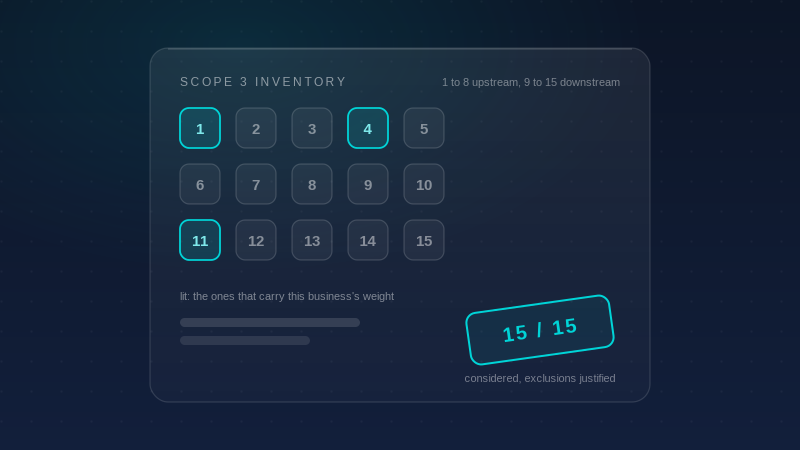
Requests from UK SRS S2 reporters are new. UK SRS S2, published on 25 February 2026, tells a reporter it "shall consider all 15 categories of Scope 3 greenhouse gas emissions" and that primary data "is more likely to be representative of the entity’s value chain activity and its greenhouse gas emissions than secondary data", giving "supplier-specific emission factors for purchased goods or services" as an example. The FCA's rules apply it to listed companies, on a comply or explain basis, for "accounting periods starting on or after 1 January 2027, with first reporting in 2028", with a one-year relief for scope 3 disclosures. The regimes behind these requests are set out in our post on scope 3 reporting rules.
What an EU customer may and may not ask you for
If your customer reports under the EU's Corporate Sustainability Reporting Directive (CSRD), EU law now limits what it can require from you. Directive (EU) 2026/470, in force since 18 March 2026, protects value chain suppliers that "do not exceed an average number of 1 000 employees". It gives them "the right to decline to provide information exceeding the information specified in the voluntary standards", and member states have until 19 March 2027 to write it into national law.
The voluntary standard followed on 21 September 2026 as Commission Delegated Regulation (EU) 2026/1560, built on the VSME standard developed by EFRAG. Article 3 says the value chain cap "shall only comprise the datapoints specified in Annex II" and applies "from the financial years beginning on or after 1 January 2027". For suppliers with more than ten employees, Annex II lists total energy consumption and one emissions item: "the Scope 1 GHG emissions in tCO2eq (from owned or controlled sources)" and "the location-based Scope 2 emissions in tCO2eq". For suppliers with ten employees or fewer it lists no emissions figure, and scope 3 is not on the list at all.
One limit matters. The right to decline covers requests made "for the purpose of sustainability reporting as required by this Directive", in the words of the directive, so a customer asking for its own targets, a rating or a tender sits outside it. The directive defines a protected supplier by headcount and by its place in a reporting company's value chain, not by where it is established. On that reading, a UK supplier with 11 to 1,000 employees can answer a CSRD-driven carbon request with energy use, scope 1 and location-based scope 2. Our earlier post covers how to raise the cap with a customer.
How do you report carbon emissions as a supplier? The eight steps
Step 1: understand the request and its format
Before calculating anything, read the request for seven things: the reporting year; the boundary (organisation, site, product or contract); the scopes and scope 3 categories named; the units (absolute tCO2e, an intensity per pound or per unit, or both); whether it wants emissions allocated to that customer; whether figures must be verified; and the deadline and submission route.
Two details are easy to miss. A well-designed request may want activity data rather than emissions: the Scope 3 Standard advises reporting companies to "Request data suppliers already have collected, such as energy-use data" in preference to emissions data, so check whether they want kilowatt hours and litres or tonnes. And a Carbon Reduction Plan is a summary, not your inventory: the Cabinet Office's technical standard says "The CRP is not intended to replace existing reporting or calculation of your organisational carbon footprint."
Step 2: set your boundary
Decide which parts of the business are in and on what basis. The PPN 006 technical standard lists three approaches from the GHG Protocol's Corporate Standard: "Financial Control", "Operational Control" and "Equity share". Pick one, write it down and apply it to every figure. For a Carbon Reduction Plan the footprint covers "your organisation’s emissions from sources in the United Kingdom", and "Suppliers should ensure that the same reporting period is used throughout the submission".
Step 3: gather your scope 1 and 2 data
Scope 1 and 2 are what almost every request wants and what your own records can answer. The GHG Protocol's Scope 3 Calculation Guidance says primary activity data "may be obtained through meter readings, purchase records, utility bills, engineering models, direct monitoring, mass balance, stoichiometry, or other methods". In practice: energy bills or meter data per site, fuel card and tank records for vehicles and plant, refrigerant top-up records, and any process emissions.
Collect quantities, not costs: a kilowatt hour converts cleanly to CO2e, a pound spent on electricity does not. If you have a renewable tariff, keep the contractual evidence too. The GHG Protocol's Scope 2 Guidance says companies in markets with contractual instruments "shall report scope 2 emissions in two ways", "one based on the location-based method, and one based on the market-based method", while the EU's voluntary standard asks suppliers for the location-based figure.
Step 4: choose which scope 3 categories to include
Let the request decide, then add what is material. The fifteen categories are explained in our scope 3 categories post.
A Carbon Reduction Plan is explicit. The technical standard requires that "All Scope 1 and Scope 2 emissions are to be included when completing your CRP, along with a subset of Scope 3 emissions", the subset being upstream transportation and distribution, waste generated in operations, business travel, employee commuting, and downstream transportation and distribution. CDP's questionnaire takes scope 3 category by category, and its technical note counts how many responders mark each one "Relevant, calculated".
Whatever you leave out, say so and why. The Scope 3 Standard requires companies to "disclose and justify any exclusions", and a stated gap is easier to defend than a silent one.
Step 5: apply the UK Government conversion factors
Convert each quantity to CO2e with the factor set for the year of your data: the 2026 conversion factors let users report emissions "from their UK activities in 2026". They were published on 11 June 2026, with a corrected flat file on 31 July 2026, and include UK grid electricity at 0.13096 kg CO2e per kWh, natural gas at 0.18231 kg CO2e per kWh (gross calorific value) and diesel (average biofuel blend) at 2.58354 kg CO2e per litre.
A Carbon Reduction Plan has no choice: the technical standard requires emissions "measured or calculated in tonnes of carbon dioxide equivalent (CO2e) using the appropriate conversion factors published by the UK Government". For every other format, name the dataset and year. The UK electricity factor fell 26% on 2025 according to the major changes report, which notes that the change reflects "two years’ worth of changes in the electricity grid mix and grid losses, rather than the usual one year". A customer comparing your two years needs to know how much of a drop is yours and how much is the grid's.
Step 6: allocate emissions to a customer if asked
Only if the request asks, and then by chapter 8 of the GHG Protocol Scope 3 Standard. The standard anticipates your position: companies "may need to allocate emissions when providing primary data to customers that are accounting for their scope 3 emissions". It defines allocation as "the process of partitioning GHG emissions" from a facility or system among its outputs.
The order is avoid, then physical, then economic. The standard says "allocation should be used only when more accurate data is not available", and its decision tree asks first whether product-level data or sub-metering can give the customer's figure directly. If not, it turns to physical factors such as mass, volume or number of units, and tells companies to choose the approach that "best reflects the causal relationship between the production of the outputs and the resulting emissions". Economic factors such as market value come last. For purchased goods the guidance table allows "Physical or economic allocation"; for shared vehicles it points to mass or volume. Freight has its own standard, ISO 14083, covered in our freight tenders post.
The arithmetic is one fraction. The standard says to "multiply total facility emissions by the reporting company’s purchases as a fraction of total production". As an illustration, a supplier whose factory emitted 1,200 tCO2e in scope 1 and 2 last year, and shipped 15% of its output by mass to one customer, allocates 180 tCO2e to that customer. Choose the factor that tracks emissions most closely, apply it consistently and "disclose the allocation metric used". The standard says "a single, consistent allocation factor should be used" for each facility and that allocated emissions "should equal 100 percent of emissions from the system", so check that your customers' shares add up to your total.
Step 7: document method, base year and data quality
Write down how you got each figure. Chapter 11 of the Scope 3 Standard requires a reporting company to publish, for each category, "a description of the methodologies, allocation methods, and assumptions used to calculate scope 3 emissions" and "a description of the data quality of reported emissions data". Give your customer a one-page method statement covering boundary, factor set and year, data sources, any allocation factor and what was estimated.
Set a base year now, even unasked. The standard says companies that track performance or set a reduction target shall "choose a scope 3 base year and specify their reasons for choosing that particular year" and develop a recalculation policy. A Carbon Reduction Plan asks for one too: the PPN 006 template has a "Baseline emissions footprint" section.
Rate your data honestly against the five data quality indicators in the Scope 3 Standard: "Technological representativeness", "Temporal representativeness", "Geographical representativeness", "Completeness" and "Reliability". Verification is not required by PPN 006: its technical standard says the footprint "should be conducted to a reasonable level of assurance" but that "there is no requirement to have your carbon footprint audited". UK SRS S2, though, tells your listed customers that an entity "shall prioritise Scope 3 greenhouse gas emissions data that is verified", and counts data "internally or externally verified". Expect the question and keep evidence an assurer could check.
Step 8: present it in the format asked
Cut the inventory to the customer's shape. For CDP that means the main questionnaire plus the "supply chain questions relevant to their customer". For a Carbon Reduction Plan, PPN 006 specifies "the template at Annex A". The technical standard says the plan must be "signed off by a director (or equivalent) or designated member (for LLPs)", and should be published "on your UK website" with the link "in a prominent place on your homepage", and "reviewed and updated within 6 months of your organisation’s financial year-end".
Keep one master inventory and map it to each format. A published Carbon Reduction Plan is visible to every customer, so the figures you give elsewhere should reconcile with it.
What are the common mistakes in supplier carbon reporting?
- A spend-based estimate when measured data was wanted. The GHG Protocol's Calculation Guidance counts "financial data, proxy data, and other generic data" as secondary data, and UK SRS S2 tells reporters to prioritise primary data, all else being equal. Say which lines are measured and which are estimated.
- Mixed factor years or reporting periods. Gas on 2025 factors beside electricity on 2026 factors gives a total nobody can compare.
- Revenue allocation when a physical factor fits. Allocating by revenue pushes emissions towards the customers who pay more per unit, whatever they bought. The Scope 3 Standard asks for the approach that best reflects how the emissions were actually caused.
- A gap in a Carbon Reduction Plan with no reason given. The plan is assessed pass or fail, and the Cabinet Office's assessment guidance expects "emissions reported for all required Scopes". Reporting "only for some Scopes, without an explanation why" is a fail; the same gap with "an acceptable explanation" is a pass.
- Handing over more than the request needs. Activity data can reveal volumes and costs. The Scope 3 Standard itself suggests reporting companies "Ask suppliers to obtain third party assurance rather than submitting detailed activity data to avoid providing confidential information". Offer allocated, documented emissions and a verification statement before the raw ledger.
How Dashe can help
Every step is easier when the data already exists. Dashe is UK carbon accounting and automated carbon reporting software. It connects to the systems a business already runs, set up with the client during a guided onboarding session, and converts the data to CO2e as it lands using the UK Government's published conversion factors, with a per-journey, per-vehicle, per-activity record behind every total.
That record is the audit trail steps 6 and 7 depend on: when a customer asks for the method behind a figure, or a site's share attributable to their contract, the activity data and the factor applied are already there. The dashboard shows scope 1, 2 and 3 separately, and reports export aligned to SECR, the UK's mandatory energy and carbon reporting regime for large companies, and to the GHG Protocol, with seven frameworks supported including CDP and ISO 14064.
Software does not set your boundary, choose your allocation factor or guarantee that a submission passes a customer's review. It does mean the next questionnaire is answered from an export rather than a project. See how Dashe supports supplier carbon reporting.
Frequently asked questions
Do I legally have to give a customer my emissions data?
Usually not by statute. The duty is contractual: a customer can make emissions data a condition of doing business, and for central government contracts above £5 million a year PPN 006 makes a Carbon Reduction Plan a condition of participation. If your customer reports under the EU's CSRD and you have up to 1,000 employees, Directive (EU) 2026/470 gives you a right to decline requests that go beyond the Commission's value chain cap, which applies to financial years beginning on or after 1 January 2027.
Can I answer a customer emissions questionnaire with a spend-based estimate?
You can, as long as you say so clearly. The GHG Protocol's Calculation Guidance includes a spend-based method, and the UK Government's conversion factors page says users should report the methods they used. A spend-based figure rests on secondary data, and UK SRS S2 tells reporters to prioritise primary data, so plan to replace spend with measured figures for the largest lines next year.
Does my supplier emissions data need to be verified?
Not under PPN 006, whose technical standard says there is no requirement to have the footprint audited, although a director must sign the plan off. Listed customers reporting under UK SRS S2 are told to prioritise verified scope 3 data, and the GHG Protocol's Scope 3 Standard suggests customers ask suppliers for assurance instead of detailed activity data. Keep records an assurer could check.
What is a carbon reduction plan for suppliers, and when do I need one?
It is the document PPN 006 requires from suppliers bidding for central government contracts above £5 million a year, for procurements advertised on or after 24 February 2025. It covers scope 1, scope 2 and five scope 3 categories, uses UK Government conversion factors, is signed off by a director, published on the supplier's UK website and updated at least annually. A private customer can ask for the same format by contract.
Conclusion
Reporting emissions as a supplier is one inventory, cut to fit each request. Understand the format, fix your boundary, take scope 1 and 2 from meters, bills and fuel records, add the scope 3 categories the request names, convert with the UK Government factors for the year of your data, allocate a customer's share only when asked and by a disclosed factor, document method, base year and data quality, and submit in the customer's shape. The formats with a published standard behind them all build on the GHG Protocol, so the work transfers between customers. The next step is to get scope 1 and 2 flowing continuously rather than annually. Dashe can help with that part.
See Dashe in action
Book a demo and see how automated carbon data works for your business.
Book a demo