Scope 3 Emissions Examples: Understanding the 15 Categories
An example for every one of the 15 scope 3 categories, the sectors where each one dominates, and which UK rules ask for them.
 Andrew WoodwardCo-founder & Managing Director 17 min read
On this page
- What are scope 3 emissions?
- Scope 3 emissions examples: the eight upstream categories
- Scope 3 emissions examples: the seven downstream categories
- Which categories matter most in your sector?
- Which categories do UK rules actually ask for?
- How to decide which categories to include
- How Dashe can help
- Frequently asked questions
- Conclusion
"Please report your scope 3 emissions" is an easy sentence to write on a questionnaire and a hard one to act on. The GHG Protocol splits scope 3 into fifteen numbered categories, and the names (upstream leased assets, processing of sold products) tell most people very little about what to actually count.
This article gives scope 3 emissions examples for every category, drawn from the standard's own definitions and from the UK government's 2026 conversion factors, so you can see which ones apply to a business like yours. It then shows which categories dominate in different sectors, which ones UK rules currently require, and how to decide what to leave out without being accused of hiding anything. Whether you are answering a customer, preparing a Carbon Reduction Plan or adopting UK SRS, the list is the same.
Quick answer: what are scope 3 emissions examples?
Scope 3 emissions are the indirect emissions in a company's value chain, outside the energy it buys. Examples include the manufacture of goods and materials it purchases, freight carried by third-party hauliers, staff flights and hotel stays, employee commuting, waste sent to landfill, and the electricity customers use to run the products it sells. The GHG Protocol groups them into 15 categories.
Key takeaways
- The GHG Protocol's Scope 3 Standard defines scope 3 as "All indirect emissions (not included in scope 2) that occur in the value chain of the reporting company" and splits it into eight upstream and seven downstream categories.
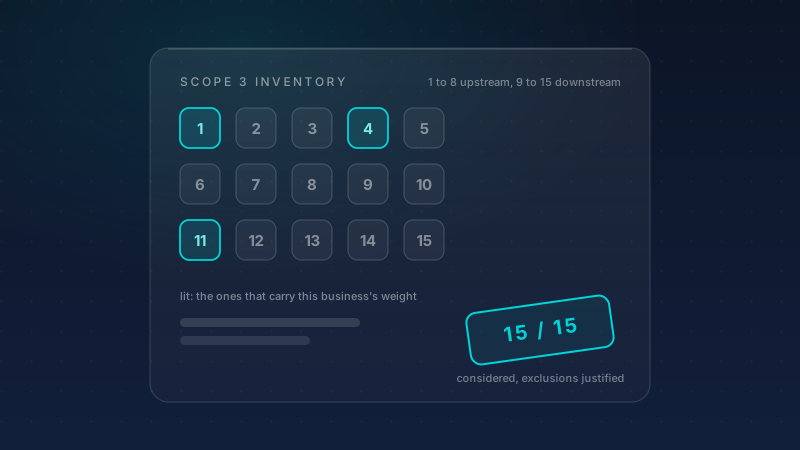
- Not every category applies to every business, but the standard requires you to "disclose and justify any exclusions", so the discipline is to consider all fifteen and document the decision.
- Category 1, purchased goods and services, is usually the largest line for a buyer of materials. For a builder or developer it is category 11, use of sold products. For a lender it is category 15, which CDP found makes up "over 99%" of the finance sector's reported total.
- In the UK, SECR requires only one slice of scope 3, PPN 006 requires five categories, and UK SRS S2 asks reporters to "consider all 15 categories".
- The cheapest data (spend) gives the least useful answer. Activity data from your own systems and supplier-specific data are what reviewers and customers increasingly expect.
What are scope 3 emissions?
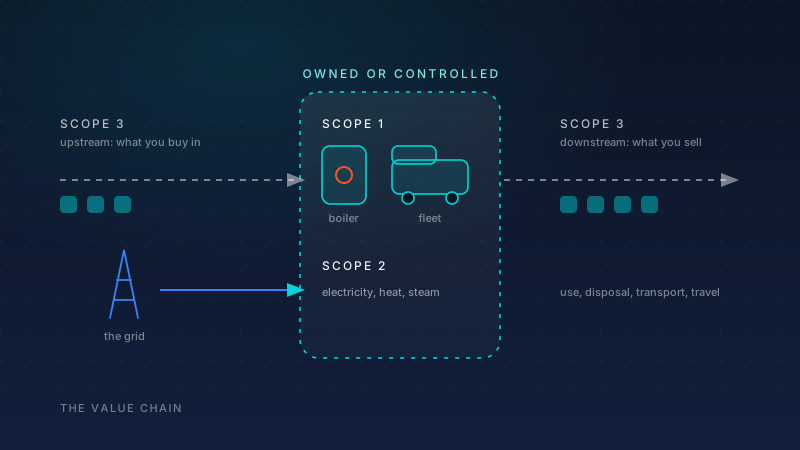
The Corporate Value Chain (Scope 3) Standard, published by the GHG Protocol in 2011, defines scope 3 as "All indirect emissions (not included in scope 2) that occur in the value chain of the reporting company, including both upstream and downstream emissions." The split follows the money: "Upstream emissions are indirect GHG emissions related to purchased or acquired goods and services. Downstream emissions are indirect GHG emissions related to sold goods and services."
Scope 3 matters because it is usually the biggest number. CDP's analysis of its corporate disclosures found that "across all sectors Scope 3 emissions account on average for 75% of total Scope 1+2+3 emissions in the sample", and a 2024 CDP and BCG report found that supply chain emissions alone were "on average, 26 times greater than their emissions from direct operations". Those figures describe large disclosing companies, but the pattern holds for most businesses that buy more than they burn.
A short test for any activity: if the fuel is burned by equipment you own or control, it is scope 1. If it is the electricity, heat or steam you buy, it is scope 2. Everything else that happens because your business exists is scope 3, and the only question is which category.
Scope 3 emissions examples: the eight upstream categories
The descriptions below are from table 5.4 of the Scope 3 Standard. The calculation methods are from the GHG Protocol's Technical Guidance for Calculating Scope 3 Emissions. Conversion factors are from the 2026 UK government dataset.
Category 1: Purchased goods and services. The "extraction, production, and transportation of goods and services purchased or acquired by the reporting company in the reporting year, not otherwise included in Categories 2 - 8". Examples: steel and timber for a contractor, packaging for a food producer, cloud hosting and professional services for an office-based firm, the water supply to a factory (0.1913 kg CO2e per cubic metre in 2026). The guidance lists four methods in descending order of accuracy: supplier-specific, hybrid, average-data (mass of goods times an industry factor) and spend-based (money spent times an input-output factor). Most first inventories start spend-based and move up.
Category 2: Capital goods. The same idea applied to long-lived assets: "extraction, production, and transportation of capital goods purchased or acquired by the reporting company in the reporting year". Examples: a new CNC machine, a fleet of vans, a warehouse fit-out, the IT estate refresh. The standard says companies "should not depreciate, discount, or amortize the emissions" but count them in the year of acquisition, so a big capex year shows as a spike.
Category 3: Fuel- and energy-related activities not included in scope 1 or 2. The upstream part of the energy you already report: extracting and refining the diesel you burn (well-to-tank), the upstream emissions of the electricity you buy, and transmission and distribution losses. In 2026 the UK factors are 0.03682 kg CO2e per kWh for upstream electricity, 0.01299 per kWh for grid losses and 0.03021 per kWh for the well-to-tank share of natural gas. This category is easy to calculate because the activity data is the same as your scope 1 and 2.
Category 4: Upstream transportation and distribution. Freight and logistics you pay for in vehicles you do not own: inbound deliveries from suppliers, third-party distribution of your products, movements between your own sites by a haulier. The guidance offers fuel-based, distance-based (mass, distance and mode of each shipment) and spend-based methods. The 2026 factors put rail freight at 0.02583 kg CO2e per tonne-kilometre and an average container ship at 0.01612, against much higher figures for road. For hauliers answering their customers, ISO 14083 is now the method tenders ask for.
Category 5: Waste generated in operations. "Disposal and treatment of waste generated in the reporting company's operations in the reporting year (in facilities not owned or controlled by the reporting company)". The 2026 factor for commercial and industrial waste to landfill is 520.58 kg CO2e per tonne, which makes landfill one of the few scope 3 lines where a single tonne is material. Water treatment also sits here (0.17088 kg CO2e per cubic metre). Methods: supplier-specific, waste-type-specific or average-data by disposal route.
Category 6: Business travel. "Transportation of employees for business-related activities during the reporting year (in vehicles not owned or operated by the reporting company)". Examples: flights, rail, taxis, hire cars, mileage in employees' own cars and hotel nights. 2026 factors: a domestic UK flight is 0.22928 kg CO2e per passenger-kilometre including radiative forcing, long-haul economy 0.11704, national rail 0.03092, an average car of unknown fuel 0.16591 per kilometre and a UK hotel night 10.4 kg CO2e. This is the one scope 3 category SECR makes mandatory for large unquoted companies and LLPs, for travel "in rental cars or employee-owned vehicles where they are responsible for purchasing the fuel".
Category 7: Employee commuting. Staff travelling "between their homes and their worksites during the reporting year (in vehicles not owned or operated by the reporting company)". The standard adds that emissions from employee teleworking are an optional inclusion. The 2026 dataset provides a homeworking factor of 0.32393 kg CO2e per full-time-equivalent working hour, covering heating and office equipment. Methods: fuel-based, distance-based (a staff survey or app data) or average national commuting patterns.
Category 8: Upstream leased assets. The "operation of assets leased by the reporting company (lessee) in the reporting year and not included in scope 1 and scope 2". In practice this catches leased buildings and equipment whose energy you do not control or meter. If you do control the leased asset, its emissions belong in scope 1 and 2 instead, so many businesses find this category empty once the boundary is set.
Scope 3 emissions examples: the seven downstream categories
Category 9: Downstream transportation and distribution. Transport and storage of your sold products "between the reporting company's operations and the end consumer (if not paid for by the reporting company), including retail and storage". The test that separates it from category 4 is who pays. If you pay the haulier, it is upstream category 4. If your customer arranges and pays for collection, it is category 9.
Category 10: Processing of sold products. "Processing of intermediate products sold in the reporting year by downstream companies (e.g., manufacturers)". A steel stockholder, a flour mill or a components maker all sell things that another factory then works on. The minimum boundary is the scope 1 and 2 emissions of those downstream processors.
Category 11: Use of sold products. "End use of goods and services sold by the reporting company in the reporting year", counted over the product's expected lifetime. Examples: the electricity a boiler, appliance or data centre draws once sold; fuel burned in vehicles a dealer sells; the operational energy of a building a developer hands over. CDP's sector analysis found this was the largest scope 3 category for construction, making up "53% of total Scope 3 emissions and 49% of total Scope 1+2+3 emissions reported by the sector" in its 2021 data.
Category 12: End-of-life treatment of sold products. "Waste disposal and treatment of products sold by the reporting company (in the reporting year) at the end of their life". Packaging is the everyday example. Buildings, vehicles and electronics are the large ones.
Category 13: Downstream leased assets. The mirror of category 8: assets you own and lease to others, "not included in scope 1 and scope 2" and reported by the lessor. A landlord's tenants' energy use, or vehicles a leasing company puts on the road.
Category 14: Franchises. The scope 1 and 2 emissions of franchisees, reported by the franchisor. Only relevant to businesses that operate a franchise model.
Category 15: Investments. "Operation of investments (including equity and debt investments and project finance) in the reporting year, not included in scope 1 or scope 2". For banks, insurers and asset managers this is the whole story. CDP's technical note records that category 15 "comprised over 99% of total Scope 3 emissions and over 99% of total Scope 1+2+3 emissions reported by the sector" for financial services, and that portfolio emissions are "on average over 700 times larger than direct emissions". UK SRS S2 adds specific disclosures on financed emissions for entities in asset management, commercial banking or insurance.
Which categories matter most in your sector?
The honest answer is that it varies more by business model than by sector label. CDP's Technical Note on the relevance of scope 3 categories by sector (version 3.0, June 2024) analysed thousands of disclosures to find where the weight sits.
| Sector | Usually dominant | CDP's finding |
|---|---|---|
| Construction and developers | Category 11, then 2 and 4 | Category 11 was "53% of total Scope 3 emissions and 49% of total Scope 1+2+3 emissions reported by the sector"; developers "should primarily measure and report Scope 3 category 2" for embodied carbon |
| Transport and logistics | Scope 1 first, then category 3 and 1 | "The majority of emissions therefore lie in Scope 1"; category 3 was "24% of total Scope 3 emissions" |
| Commercial real estate | Categories 2, 3, 11 | "Scope 3 emissions on average contribute over 85% of a commercial Real Estate company's entire footprint" |
| Capital goods manufacturers | Category 11 | "Value chain emissions account for more than 90% of emissions from the Capital Goods sector" |
| Financial services | Category 15 | "over 99% of total Scope 1+2+3 emissions reported by the sector" |
For a professional services or software business none of these dominate. Purchased services, business travel, commuting and home working carry the footprint, and the numbers are small in absolute terms but large as a share.
Which categories do UK rules actually ask for?
| Requirement | Scope 3 categories required |
|---|---|
| SECR (large unquoted companies and LLPs) | Part of category 6 only: business travel in hire or employee-owned vehicles where the company buys the fuel. "Other Scope 3 emissions voluntary, but strongly encouraged where this is a material source of emissions." |
| PPN 006 Carbon Reduction Plans (suppliers bidding for central government contracts over £5 million a year) | Five named categories: "Upstream transportation and distribution", "Waste generated in operations", "Business travel", "Employee commuting", "Downstream transportation and distribution" (categories 4, 5, 6, 7 and 9) |
| UK SRS S2 (voluntary now; listed companies on a comply-or-explain basis from 2027 under FCA PS26/19) | The entity "shall consider all 15 categories" and "shall disclose which of these categories are included". A transitional relief (paragraph C4) allows scope 3 to be omitted, with the relief disclosed. |
| SBTi Corporate Net-Zero Standard V2.0 (June 2026) | Category A companies must report scope 3 and identify the categories that account for "5% or more" of scope 3 categories 1 to 14 |
| EU CSRD reporters' supply chains | Companies with up to 1,000 employees cannot be asked for more than the voluntary SME standard sets out, under Directive (EU) 2026/470 |
If you supply the public sector, the five PPN 006 categories are the sensible first scope 3 build, because they are the ones an evaluator will check. If you supply listed companies, expect to be asked for whatever feeds their category 1.
How to decide which categories to include
The Scope 3 Standard is clear on the principle: "Companies shall account for all scope 3 emissions as defined in this standard and disclose and justify any exclusions." It then gives seven criteria (table 6.1) for judging whether an activity is relevant, and the first four do most of the work. Size: "They contribute significantly to the company's total anticipated scope 3 emissions". Influence: "There are potential emissions reductions that could be undertaken or influenced by the company". Risk: "They contribute to the company's risk exposure". Stakeholders: "They are deemed critical by key stakeholders (e.g., customers, suppliers, investors, or civil society)".
A practical process for a first inventory:
- Screen all fifteen with spend data. A rough spend-based estimate for every category takes an afternoon with the finance ledger and tells you where the weight is.
- Rank them. Categories that together make up the bulk of the estimate are in. Categories that are small and outside your influence can be excluded with a one-line justification.
- Upgrade the big ones. Replace spend with activity data (litres, kilometres, tonnes, kWh) from your own systems, then with supplier-specific data where a supplier can give it.
- Write the exclusions down. "Category 14, franchises: not applicable, the company does not operate franchises" is a perfectly good justification. Silence is not.
The bar is rising. The GHG Protocol's March 2026 progress update on revising the Scope 3 Standard proposes that companies "must report at least 95% of total required scope 3 emissions" and that exclusions are "capped at 5%". It also proposes a new category 16 for "other value chain activities". The document says its contents are "not subject to public consultation at this time", and the GHG Protocol has since announced it will fold the revision into a single standard with ISO, with consultation planned for Q2 2027. Nothing has changed yet, but a 95% completeness floor is the direction of travel.
How Dashe can help
The categories that give businesses the most trouble are the ones with no system behind them: business travel, commuting and home working. Dashe addresses that directly. The Dashe app detects staff journeys in the background and records transport mode, distance and CO2e per journey without forms, so categories 6 and 7 come from real movements rather than an annual survey. The app was built to protect users' privacy and is GDPR compliant.
For the categories that do live in systems, Dashe connects to the ones a business already runs, including fleet telematics, meters and finance, and converts the data to CO2e as it lands. Scope 1, 2 and 3 totals sit in one live dashboard with a category breakdown, and reports export aligned to SECR and the GHG Protocol.
Software will not decide for you which of the fifteen categories are relevant, and it does not guarantee compliance with any regime. What it does is keep the categories you include current, so the next questionnaire is an export rather than a project. Explore how Dashe captures scope 3 data.
Frequently asked questions
Is employee commuting a scope 3 emission?
Yes. Commuting is scope 3 category 7, covering travel between home and the workplace in vehicles the employer does not own or operate. It is voluntary under SECR, one of the five required categories in a PPN 006 Carbon Reduction Plan, and within the fifteen categories UK SRS S2 asks reporters to consider. Home working can be included alongside it as an optional item.
Are home working emissions scope 2 or scope 3?
Scope 3. The energy is used at employees' homes, which the business does not own or control, so it cannot be scope 2. The Scope 3 Standard lists teleworking as an optional part of category 7. The 2026 UK conversion factors include a homeworking factor of 0.32393 kg CO2e per full-time-equivalent working hour, so it can be estimated without collecting household bills.
Are leased vehicles scope 1 or scope 3?
It depends on control. If you lease a van and your business decides how and where it is driven, under the operational control approach its fuel is scope 1. If you lease an asset but do not control its operation, it falls into category 8. Most company car and van leases end up in scope 1. Employees' own cars on business are always category 6.
What is the difference between category 4 and category 9?
Both cover transport of goods in vehicles you do not own. Category 4 is transport you pay for, including inbound supplies and outbound deliveries you arrange. Category 9 is transport of your sold products that the customer pays for, plus downstream storage and retail. The Scope 3 Standard draws the line at "if not paid for by the reporting company".
Does scope 3 double count emissions between companies?
Yes, by design. Your category 1 includes your supplier's scope 1 and 2, and your scope 1 appears in your customer's category 1. The Scope 3 Standard allows this because each company's inventory is its own view of the value chain. The problem only arises if you add different companies' scope 3 totals together, which the standard does not intend.
What is scope 3 category 16?
A proposal, not a rule. The GHG Protocol's March 2026 progress update proposes "a new category 16 for other value chain activities", including facilitated emissions where a company earns income from an activity it never buys, sells or owns, such as licensing. The draft says most subcategories would be optional. It is not in the current standard and no UK rule references it.
Conclusion
Scope 3 is fifteen categories, but for most businesses three or four of them hold almost all the weight: purchased goods and capital goods for anyone who buys materials, use of sold products for anyone who makes or builds things that consume energy, investments for anyone who lends, and travel, commuting and home working for everyone else. The standard asks you to consider all fifteen, keep the significant ones and justify the rest, and UK rules from PPN 006 to UK SRS S2 build on exactly that list. Start with a spend-based screen, upgrade the big categories to real activity data, and write your exclusions down. Dashe can keep the travel and commuting data flowing while you do.
See Dashe in action
Book a demo and see how automated carbon data works for your business.
Book a demo