Scope 1, 2 and 3 Emissions Explained for Businesses
What each scope covers, which UK rules require them, and a worked example with the 2026 conversion factors.
 Andrew WoodwardCo-founder & Managing Director 16 min read
On this page
- Where do the three scopes come from?
- What are Scope 1 emissions?
- What are Scope 2 emissions?
- What are Scope 3 emissions?
- Which UK rules ask for which scopes?
- A worked example with 2026 UK conversion factors
- Three mistakes that distort a first footprint
- How Dashe can help
- Frequently asked questions
- Conclusion
At some point a customer questionnaire, a tender or a regulation asks for your greenhouse gas emissions "by scope", and the request assumes you already know what that means. Most people running a business do not, because the three scopes come from a technical accounting standard rather than from everyday language.
This guide has scope 1, 2 and 3 emissions explained in plain English. It covers what each scope includes, where the definitions come from, which UK rules currently ask for which scopes, and how a real business splits across them using the government's 2026 conversion factors. It matters now because UK reporting is widening: the FCA finalised rules for listed companies in September 2026, public tenders over £5 million a year already require scope data, and large customers pass their own obligations down their supply chains.
Quick answer: what are scope 1, 2 and 3 emissions?
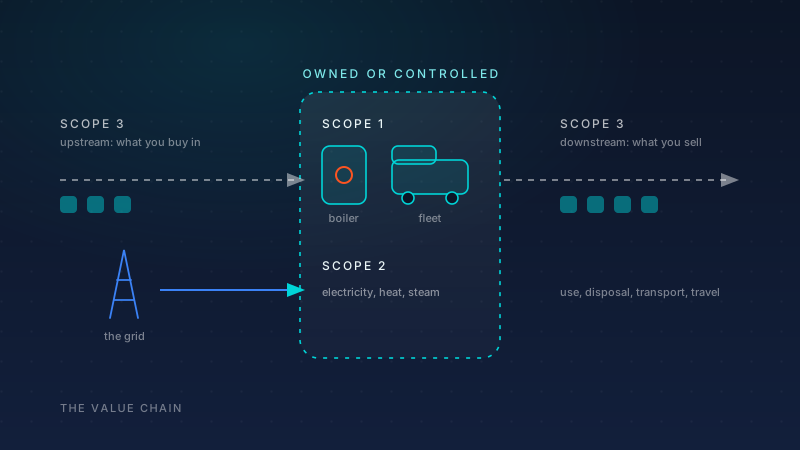
Scope 1 is greenhouse gas emitted directly by sources your business owns or controls, such as gas boilers and company vehicles. Scope 2 is the indirect emissions from the electricity, heat, steam or cooling you buy. Scope 3 is every other indirect emission in your value chain, from the goods you purchase to the use and disposal of what you sell. The categories were defined by the GHG Protocol.
Key takeaways
- The three scopes are defined by the GHG Protocol Corporate Standard, which requires companies to "separately account for and report on scopes 1 and 2 at a minimum". Scope 3 is split into 15 categories by a separate 2011 standard.
- Scope 3 is usually the largest share. CDP's analysis of its disclosure data found scope 3 "account on average for 75% of total Scope 1+2+3 emissions".
- In the UK, SECR requires scope 1 and 2 for large companies and only one slice of scope 3. PPN 006 requires scope 1, 2 and five scope 3 categories from suppliers bidding for major government contracts. UK SRS S2 asks for all three, with transitional relief for scope 3.
- The 2026 UK electricity factor fell 26% on 2025, so a scope 2 figure can drop with no change in behaviour. Always state which year's factors you used.
- Whether an activity sits in scope 1 or scope 3 depends on ownership or control, not on how important it feels. Fuel in a company van is scope 1. Fuel in an employee's own car on business is scope 3.
Where do the three scopes come from?
The scopes were created by the Greenhouse Gas Protocol, a partnership between the World Resources Institute and the World Business Council for Sustainable Development. Its Corporate Accounting and Reporting Standard splits an organisation's emissions by who owns the source: "Direct GHG emissions are emissions from sources that are owned or controlled by the company. Indirect GHG emissions are emissions that are a consequence of the activities of the company but occur at sources owned or controlled by another company."
The standard then draws the line between the scopes so that no two companies count the same tonne in the same scope. It states that "Companies shall separately account for and report on scopes 1 and 2 at a minimum", and describes scope 3 as "an optional reporting category that allows for the treatment of all other indirect emissions". The optional label is the original 2004 position. As the next sections show, UK rules and customer requirements have since made parts of scope 3 anything but optional.
Almost every framework you will meet in the UK builds on these definitions. UK SRS S2 requires emissions to be measured "in accordance with the Greenhouse Gas Protocol: A Corporate Accounting and Reporting Standard (2004)". PPN 006 says a supplier's "carbon footprint should adhere to the Greenhouse Gas Protocol's Corporate Accounting and Reporting Standard". Learn the scopes once and the frameworks become variations on one theme.
What are Scope 1 emissions?
Scope 1 covers greenhouse gases released directly from things your organisation owns or controls. The Corporate Standard gives the examples of "emissions from combustion in owned or controlled boilers, furnaces, vehicles, etc.; emissions from chemical production in owned or controlled process equipment".
For a typical UK business that means:
- Natural gas burned in your own boilers and ovens
- Diesel and petrol burned in company-owned or leased vehicles, vans, HGVs and plant
- Fuel burned in generators and forklifts on your sites
- Refrigerant gases leaking from air conditioning and chillers
- Process emissions, for example from cement, chemicals or anaerobic digestion
The practical test is ownership or control, which depends on the consolidation approach you choose (equity share, financial control or operational control). A van on your fleet is scope 1. An employee's own car driven to a client meeting is not, even if you reimburse the mileage. That journey is scope 3, category 6.
What are Scope 2 emissions?
Scope 2 is the indirect emissions from energy you buy. The Corporate Standard says "Scope 2 accounts for GHG emissions from the generation of purchased electricity consumed by the company", and extends the same treatment to purchased heat, steam and cooling. The emissions "physically occur at the facility where electricity is generated", which is why they are indirect rather than direct.
Since 2015 the GHG Protocol's Scope 2 Guidance has required companies operating in markets where contractual instruments such as renewable tariffs are available to report scope 2 two ways, "one based on the location-based method, and one based on the market-based method. This is also termed 'dual reporting.'" The location-based method "reflects the average emissions intensity of grids on which energy consumption occurs". The market-based method "reflects emissions from electricity that companies have purposefully chosen (or their lack of choice)". If you have a green tariff, report both numbers and say which is which.
For UK reporters the location-based factor comes from the government's annual conversion factors. The 2026 edition, published on 11 June 2026, puts UK grid electricity at 0.13096 kg CO2e per kWh. That is a 26% fall on the 2025 factor. The major changes report attributes most of the decrease to "grid decarbonisation between 2023-2024" and to a methodology change that reduced the data lag from two years to one. A business that used the same electricity in both years will see its scope 2 fall by about a quarter without doing anything, which is why reports must state the factor year used.
What are Scope 3 emissions?
Scope 3 is everything else. The GHG Protocol's Corporate Value Chain (Scope 3) Standard defines it as "All indirect emissions (not included in scope 2) that occur in the value chain of the reporting company, including both upstream and downstream emissions." It divides the scope by the direction of money: "Upstream emissions are indirect GHG emissions related to purchased or acquired goods and services. Downstream emissions are indirect GHG emissions related to sold goods and services."
The standard groups scope 3 into 15 categories.
| Upstream (categories 1 to 8) | Downstream (categories 9 to 15) |
|---|---|
| 1. Purchased goods and services | 9. Downstream transportation and distribution |
| 2. Capital goods | 10. Processing of sold products |
| 3. Fuel- and energy-related activities (not in scope 1 or 2) | 11. Use of sold products |
| 4. Upstream transportation and distribution | 12. End-of-life treatment of sold products |
| 5. Waste generated in operations | 13. Downstream leased assets |
| 6. Business travel | 14. Franchises |
| 7. Employee commuting | 15. Investments |
| 8. Upstream leased assets |
Not every category applies to every business. A consultancy has no sold products to process. A haulier's largest line is usually category 4 or its own scope 1 fleet. The Scope 3 Standard requires companies to "account for all scope 3 emissions as defined in this standard and disclose and justify any exclusions", so the discipline is to look at every category and explain the ones you leave out.
Scope 3 is where most of the emissions sit. The Scope 3 Standard itself says it "can represent the largest source of emissions for companies and present the most significant opportunities to influence GHG reductions". The evidence from disclosure data backs that up. CDP's technical note on scope 3 relevance, analysing its corporate questionnaire responses, found that "across all sectors Scope 3 emissions account on average for 75% of total Scope 1+2+3 emissions in the sample". A June 2024 CDP and BCG report went further for the supply chain alone: "In 2023, corporates reported that their Scope 3 supply chain emissions were, on average, 26 times greater than their emissions from direct operations". The same report found that "only 15% have set a Scope 3 target". Both figures describe companies that disclose to CDP, which skews large, but the direction holds across sectors.
Which UK rules ask for which scopes?
This is the question most readers actually have. The answer depends on who you are and who you sell to.
| Requirement | Who it applies to | Scope 1 | Scope 2 | Scope 3 |
|---|---|---|---|---|
| SECR (Companies Act, since 2019) | Quoted companies, plus unquoted companies and LLPs meeting two of: £36m turnover, £18m balance sheet, 250 employees | Required | Required | Mostly voluntary. Large unquoted companies and LLPs must include business travel in hire or employee-owned cars where they buy the fuel |
| PPN 006 (Carbon Reduction Plans) | Suppliers bidding for central government contracts over £5m a year, procurements advertised from 24 February 2025 | Required | Required | Five categories required: upstream and downstream transport, waste, business travel, employee commuting |
| UK SRS S2 via FCA PS26/19 | Listed companies, accounting periods from 1 January 2027, on a comply-or-explain basis | Required | Required | Required, with one year of transitional relief |
| UK SRS S2, voluntary use | Any UK entity that chooses to adopt it | Required | Required | Relief available: "not required to disclose its Scope 3 greenhouse gas emissions" (paragraph C4) |
| SBTi Corporate Net-Zero Standard V2.0 (June 2026) | Companies setting validated targets | Required | Required | Category A companies "shall also report scope 3 emissions within their GHG inventory" and set a separate scope 3 target |
| Customer questionnaires | Any supplier to a large company | Expected | Expected | Increasingly expected, though EU rules now cap what CSRD reporters can demand from suppliers with 1,000 employees or fewer |
Two things stand out. First, scope 1 and 2 appear in every row, so they are the non-negotiable baseline for any UK business asked about carbon. Second, scope 3 arrives through the supply chain long before it arrives through the law. If you supply a listed company, a government department or an EU-regulated group, their scope 3 is your scope 1 and 2, and they will ask.
SECR itself is under review. The government's post-implementation review, published on 26 May 2026, concluded that "the overarching recommendation is to retain the SECR requirements with amendments". It also noted "confusion arising from SECR's selective inclusion of certain Scope 3 categories (e.g. business travel) while excluding others", and flagged a planned 2026 consultation on streamlining energy and emissions reporting. Expect the scope 3 question in SECR to be revisited, not dropped.
A worked example with 2026 UK conversion factors
Here is how a hypothetical 120-person engineering business with one site and a small van fleet splits across the scopes, using factors from the 2026 government dataset. Figures are illustrative and rounded.
| Activity | Annual quantity | 2026 factor | Emissions | Scope |
|---|---|---|---|---|
| Natural gas for heating | 100,000 kWh | 0.18231 kg CO2e/kWh | 18.2 tCO2e | 1 |
| Diesel in company vans | 20,000 litres | 2.58354 kg CO2e/litre | 51.7 tCO2e | 1 |
| Grid electricity | 250,000 kWh | 0.13096 kg CO2e/kWh | 32.7 tCO2e | 2 (location-based) |
| Transmission and distribution losses on that electricity | 250,000 kWh | 0.01299 kg CO2e/kWh | 3.2 tCO2e | 3, category 3 |
| Well-to-tank emissions of that electricity | 250,000 kWh | 0.03682 kg CO2e/kWh | 9.2 tCO2e | 3, category 3 |
| Staff driving their own cars on business | 150,000 km | 0.16591 kg CO2e/km (average car, unknown fuel) | 24.9 tCO2e | 3, category 6 |
Scope 1 comes to 69.9 tCO2e, scope 2 to 32.7 tCO2e and the three scope 3 lines shown to 37.3 tCO2e, all from the 2026 dataset. Notice what is missing: purchased goods and services, capital goods, commuting, waste and freight. For a business that buys steel, components and subcontract labour, category 1 alone would normally dwarf everything in the table. That is the general pattern: the lines you can read off a bill are small and precise, and the lines that need supplier data are large and estimated.
Three mistakes that distort a first footprint
- Putting employee cars in scope 1. Grey fleet mileage is scope 3, category 6. SECR makes it explicit for large unquoted companies: business travel "in rental cars or employee-owned vehicles where they are responsible for purchasing the fuel" is required, but it is still reported as scope 3.
- Mixing factor years. Using 2025 factors for gas and 2026 factors for electricity makes the trend meaningless. Pick the year's dataset that matches your reporting period and say so.
- Treating a green tariff as zero. Under the Scope 2 Guidance you report both the location-based and the market-based figure. Reporting only the market-based zero hides the grid you actually draw from, and reviewers know to look for both.
How Dashe can help
Splitting emissions by scope is easy to describe and tedious to maintain, because the data lives in different systems: meters, fuel cards, finance, fleet telematics and people's own cars. Dashe connects to the systems a business already runs and converts the data to CO2e as it lands, so scope 1, 2 and 3 totals sit in one live dashboard rather than in a spreadsheet rebuilt each year.
Two features bear directly on the problems in this article. Each vehicle carries its own emission factor from a DVLA or VIN lookup rather than a fleet average, which keeps scope 1 fleet figures defensible. And the Dashe app detects staff journeys in the background, recording transport mode, distance and CO2e without forms, which is the part of scope 3 that most businesses otherwise estimate. Reports export aligned to SECR and the GHG Protocol.
Software does not decide which scope an activity belongs in or guarantee compliance with any regime. It does make the numbers current and traceable when the questionnaire arrives. See how Dashe handles scope 1, 2 and 3 in practice.
Frequently asked questions
What is the difference between scope 1 and scope 2 emissions?
Scope 1 is emitted by equipment and vehicles your organisation owns or controls, such as a gas boiler or a company van. Scope 2 is emitted elsewhere, at the power station generating the electricity, heat or steam you buy. Both are about your own operations. The difference is whether the fuel is burned on your side of the meter or the supplier's.
Are scope 3 emissions mandatory in the UK?
Partly. SECR requires large unquoted companies and LLPs to include business travel in hire or employee-owned vehicles where they buy the fuel, and leaves the rest voluntary. PPN 006 requires five scope 3 categories from suppliers bidding for government contracts over £5 million a year. UK SRS S2 requires scope 3 from listed companies on a comply-or-explain basis from 2027, with a year's relief.
Is working from home scope 2 or scope 3?
Scope 3. Home working energy is consumed at sources your business does not own or control. The 2026 UK conversion factors include a homeworking factor of 0.32393 kg CO2e per full-time-equivalent working hour, covering office equipment and heating, so it can be estimated without collecting every employee's bills.
Which scope are electric vehicles in?
The electricity charged into a company-owned EV is scope 2, because you are buying the energy. The emissions are not zero: the 2026 UK grid factor is 0.13096 kg CO2e per kWh. Charging an employee's own EV for business journeys is scope 3, category 6, in the same way as fuel in a privately owned petrol car.
What are scope 4 emissions?
"Scope 4" is an informal term for avoided emissions, the reductions a product enables elsewhere, such as insulation cutting a customer's heating. It is not part of the GHG Protocol's corporate scopes and should not be netted off scope 1, 2 or 3. If you report avoided emissions, present them separately with the method explained.
Are the scope definitions about to change?
The GHG Protocol is revising its standards and announced on 29 July 2026 that it will combine them with ISO 14064-1 into a single standard, with public consultation planned for Q2 2027. A March 2026 progress update proposed a rule requiring companies to "report at least 95% of total required scope 3 emissions" and a new category 16, but states its contents are "not subject to public consultation at this time". The 2004 definitions remain the ones every UK rule cites today.
Conclusion
Scope 1 is what you burn, scope 2 is what you buy in energy, and scope 3 is everyone else's emissions that your business causes. The split comes from the GHG Protocol and is reused by SECR, PPN 006, UK SRS and the SBTi, so understanding it once answers most of the questions a customer, tender or auditor will put to you. Scope 1 and 2 are the baseline every regime requires. Scope 3 is usually three-quarters of the total and arrives through your supply chain before it arrives through the law. The sensible next step is to get scope 1 and 2 flowing from real data, then work through the 15 scope 3 categories and document which ones apply. Dashe can help keep that data current.
See Dashe in action
Book a demo and see how automated carbon data works for your business.
Book a demo


