Scope 3 Reporting: Rules and Practical Requirements for UK Businesses
What SECR, PPN 006, UK SRS S2 and the FCA actually require on scope 3, what customers can ask for, and what a defensible report contains.
 Andrew WoodwardCo-founder & Managing Director 17 min read
On this page
- Is scope 3 reporting mandatory in the UK?
- What does SECR require on scope 3?
- What do Carbon Reduction Plans under PPN 006 require?
- What does UK SRS S2 require, and who has to apply it?
- What do EU customers and voluntary standards expect?
- What a defensible scope 3 report contains
- How Dashe can help
- Frequently asked questions
- Conclusion
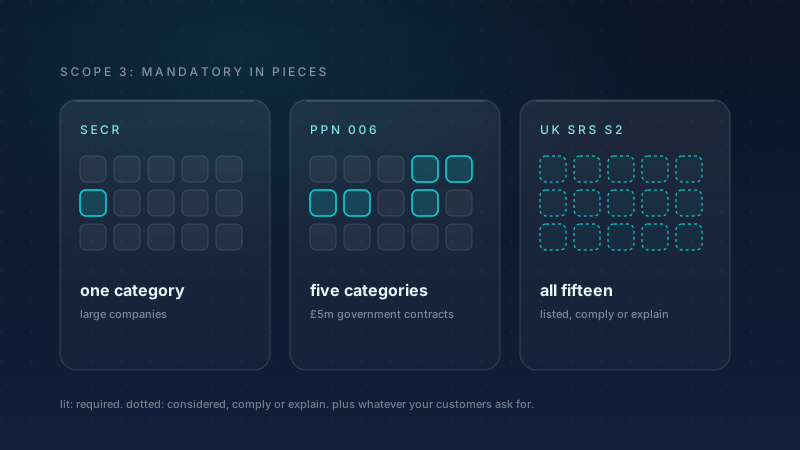
Scope 3 reporting has a reputation for being optional, and until recently that was mostly true. In 2026 it is a patchwork. One slice is mandatory under SECR, five categories are a condition of bidding for major government contracts, listed companies will report it on a comply-or-explain basis from 2027, and large customers ask for it regardless of what the law says.
This article sets out the scope 3 reporting rules that apply to UK businesses as they stand in November 2026: what SECR, PPN 006, UK SRS S2 and the FCA actually require, what EU customers can and cannot ask of their suppliers, and what the voluntary standards expect. It then turns to the practical requirements, meaning what a scope 3 report has to contain to survive an evaluator, an auditor or a sceptical customer. Where a rule is still a proposal, it says so.
Quick answer: is scope 3 reporting mandatory in the UK?
Partly. SECR requires large unquoted companies and LLPs to report business travel in hire or employee-owned vehicles where they buy the fuel, and leaves other scope 3 voluntary. PPN 006 requires five scope 3 categories from suppliers bidding for central government contracts over £5 million a year. Listed companies must report scope 3 under UK SRS S2 on a comply-or-explain basis for periods from 1 January 2027. Other businesses face no direct legal duty yet.
Key takeaways
- SECR's scope 3 requirement is narrow and is being reviewed. The government's May 2026 post-implementation review recommended keeping SECR "with amendments" and flagged "confusion arising from SECR's selective inclusion of certain Scope 3 categories".
- A PPN 006 Carbon Reduction Plan must cover scope 1, scope 2 and five named scope 3 categories, be director-approved, published on your website and updated annually.
- The FCA's final rules (PS26/19, 30 September 2026) apply UK SRS to listed companies "on a comply or explain basis" for accounting periods from 1 January 2027, with "a 1-year transitional relief for Scope 3 disclosures".
- UK SRS S2 requires reporters to "consider all 15 categories" and to say which are included. Voluntary adopters may use a relief that omits scope 3, as long as they disclose it.
- EU rules now cap what CSRD reporters can demand from suppliers with up to 1,000 employees. The SBTi's 2026 standard requires scope 3 targets from larger companies only.
Is scope 3 reporting mandatory in the UK?
There is no single UK law that says "report your scope 3 emissions". There are four routes by which the obligation arrives, and most businesses are on at least one of them.
| Route | Who it reaches | Scope 3 requirement | Status, October 2026 |
|---|---|---|---|
| SECR (Companies Act 2006 regulations) | Quoted companies; unquoted companies and LLPs meeting two of £36m turnover, £18m balance sheet, 250 employees | Business travel in hire or employee-owned vehicles where the company buys the fuel. Rest voluntary | In force since 2019; review recommends retaining with amendments |
| PPN 006 Carbon Reduction Plans | Suppliers bidding for central government contracts over £5m a year | Five categories: upstream and downstream transport, waste, business travel, commuting | In force for procurements advertised from 24 February 2025 |
| UK SRS S2 via FCA listing rules | Listed companies | All 15 categories considered, comply or explain, one year's relief | Final rules 30 September 2026; periods from 1 January 2027 |
| Customers and lenders | Any supplier to a large or listed company, or to an EU CSRD reporter | Whatever the customer's own category 1 needs | Contractual, not statutory; EU cap limits requests to smaller suppliers |
The sections below take each route in turn.
What does SECR require on scope 3?
SECR applies to quoted companies and to unquoted companies and LLPs that are "large" on the Companies Act test the government guidance reproduces: two or more of "Turnover £36 million or more", "Balance sheet total £18 million or more" and "Number of employees 250 or more". Those thresholds did not move when the general company size limits rose in April 2025, a trap covered in our SECR thresholds post.
On scope 3 the guidance is precise. It is "Voluntary for quoted companies but strongly encouraged, especially where this is a material source of emissions", and "Mandatory for large unquoted companies and LLPs to disclose energy use and related emissions from business travel in rental cars or employee-owned vehicles where they are responsible for purchasing the fuel. Other Scope 3 emissions voluntary, but strongly encouraged where this is a material source of emissions."
So for an unquoted company the mandatory scope 3 content is grey fleet mileage and nothing else. In practice that single line, plus the energy figures around it, is what a Companies House reader will see.
SECR is under review. DESNZ published its post-implementation review on 26 May 2026. Its conclusion: "the overarching recommendation is to retain the SECR requirements with amendments, implementing targeted reforms to improve effectiveness, reduce duplication, and ensure coherence with the evolving reporting landscape." On scope 3 specifically, interviewees "highlighted confusion arising from SECR's selective inclusion of certain Scope 3 categories (e.g. business travel) while excluding others." The review says improvements "will be explored through the planned 2026 consultation on streamlining energy and emissions reporting", including "Aligning SECR definitions and metrics with ISSB, CSRD and TCFD". That consultation had not opened at the time of writing. A separate Department for Business consultation, Modernising corporate reporting, published 7 September 2026 and closing 30 November 2026, proposes moving SECR disclosures out of the directors' report into the first half of the annual report.
What do Carbon Reduction Plans under PPN 006 require?
If you bid for central government work, PPN 006 is the scope 3 rule that bites first. It applies "to all central government departments, their executive agencies and non-departmental public bodies", for contracts with "an estimated contract value above £5 million per year" including VAT, on "procurements advertised on or after 24 February 2025". The value is averaged over the life of the contract, so a four-year £21 million contract is in scope even if year one is under £5 million, as our PPN 006 post explains.
The technical standard sets the emissions content: "All Scope 1 and Scope 2 emissions are to be included when completing your CRP, along with a subset of Scope 3 emissions." The subset is five named categories: "Upstream transportation and distribution", "Waste generated in operations", "Business travel", "Employee commuting" and "Downstream transportation and distribution". The footprint "should adhere to the Greenhouse Gas Protocol's Corporate Accounting and Reporting Standard", and "suppliers must confirm their organisational commitment to achieving Net Zero by 2050 at the latest". The plan must be "published and clearly signposted on the supplier's UK website", approved at director level and updated annually.
PPN 006 is a condition of participation rather than a scored criterion, so a missing category is a fail, not a lost mark. For construction and infrastructure suppliers the same five categories are increasingly requested by main contractors on private work too.
What does UK SRS S2 require, and who has to apply it?
UK SRS S2, published by the Department for Business and Trade on 25 February 2026, is the UK version of the ISSB's IFRS S2. Paragraph 29 requires an entity to disclose its gross greenhouse gas emissions "classified as: (1) Scope 1 greenhouse gas emissions; (2) Scope 2 greenhouse gas emissions; and (3) Scope 3 greenhouse gas emissions", measured "in accordance with the Greenhouse Gas Protocol: A Corporate Accounting and Reporting Standard (2004)". On scope 3 the application guidance is explicit: "The entity shall consider its entire value chain (upstream and downstream) and shall consider all 15 categories of Scope 3 greenhouse gas emissions, as described in the Greenhouse Gas Protocol Corporate Value Chain (Scope 3) Accounting and Reporting Standard (2011)." It must then "disclose which of these categories are included". The standard also sets a data hierarchy: the entity "shall prioritise", with all else being equal, "the use of primary data", which it defines to include "meter readings, utility bills" and "supplier-specific emission factors for purchased goods or services".
Two reliefs matter. Paragraph C4 says "An entity that applies this Standard is not required to disclose its Scope 3 greenhouse gas emissions". Paragraph C3 allows a different measurement method in the first year if it was already in use. UK SRS S1 paragraph 73A confirms that an entity using these "is not prevented from asserting compliance with UK SRS S2, but it shall disclose its use of those provisions alongside its statement of compliance". For voluntary adopters the government removed the one-year time limit on the scope 3 relief that IFRS S2 carries, so a voluntary reporter can use it for as long as it is not required to report by law. Paragraph C6 makes the relief "subject to any rules... determined by the Financial Conduct Authority" for companies the FCA regulates.
Who must apply it. Today, nobody is obliged to by company law. The government's guidance page says the standards "are available for voluntary use, by any entity that chooses to do so" and that it "will consider whether to introduce requirements for certain UK entities to report against these standards". The Modernising corporate reporting consultation says the government "will consider how the UK SRS should be reflected in the Companies Act 2006".
The FCA has moved first. PS26/19, published 30 September 2026, states: "Our final rules adopt a comply or explain approach across the UK SRS." It confirms "The rules will apply to accounting periods beginning on 1 January 2027, with first reporting in 2028" and that "we are providing a 1-year transitional relief for Scope 3 disclosures and a 2-year transitional relief for S1 disclosures." The FCA explains the scope 3 relief by noting that "many issuers face challenges accessing the data needed to make Scope 3 emissions disclosures." In-scope issuers will also have to say "whether or not they have obtained third-party sustainability assurance" over their UK SRS disclosures and whether they have a climate-related transition plan, and if not, why not.
The practical consequence for unlisted businesses is indirect but real. A listed customer reporting scope 3 from 2027, even on comply or explain, needs supplier data to populate category 1. The explain option exists, but a company that explains year after year why it cannot measure its supply chain is not the one most boards want to be.
What do EU customers and voluntary standards expect?
CSRD after Omnibus I. The EU narrowed its Corporate Sustainability Reporting Directive on 26 February 2026 with Directive (EU) 2026/470, in force from 18 March 2026. Mandatory reporting now applies to undertakings that "exceed a net turnover of EUR 450 000 000 and an average number of 1 000 employees during the financial year". Fewer companies report, and the ones that do are constrained in what they can ask of suppliers. Reporting standards "shall not specify disclosures that would require undertakings to obtain from undertakings in their value chain which... do not exceed an average number of 1 000 employees... any information that exceeds the information to be disclosed pursuant to the sustainability reporting standards for voluntary use". That voluntary standard is the VSME, whose Basic Module covers energy and scope 1 and 2 emissions. UK suppliers to EU-regulated customers are covered by the cap; our earlier post explains how to use it.
Science Based Targets initiative. The SBTi published Corporate Net-Zero Standard V2.0 in June 2026. Its criteria split companies into Category A (net turnover of €450 million or more, or 1,000 or more full-time staff, or in high-income countries companies with scope 1 and 2 emissions of 10,000 tCO2e or more, or meeting two of €25 million balance sheet, €50 million turnover and 250 staff) and Category B (everyone else). Criterion C5.2 states: "Category A and Category B companies shall account and report scope 1 and scope 2 emissions, and Category A companies shall also report scope 3 emissions within their GHG inventory." Category A companies "shall set separate scope 1, scope 2, and scope 3 targets" and must identify the scope 3 categories that account for "5% or more" of scope 3 categories 1 to 14. For Category B, scope 3 targets are optional.
The GHG Protocol itself. The standard everything else cites is being revised. A March 2026 progress update proposes that companies "must report at least 95% of total required scope 3 emissions", that reported scope 3 be split into tiers by data type, and a new category 16. The document is "not subject to public consultation at this time". On 29 July 2026 the GHG Protocol announced it will combine its corporate standards with ISO 14064-1 into a single standard, "with an integrated public consultation on the future corporate standard planned for Q2 2027". The 2011 Scope 3 Standard remains the one UK SRS and PPN 006 reference until then.
What a defensible scope 3 report contains
Rules aside, the practical requirements are the same whoever is reading. A scope 3 report that stands up contains the following.
- A stated boundary. Which entities are in, and whether you use the equity share, financial control or operational control approach. The GHG Protocol requires this choice to be made and applied consistently, and it decides whether a leased van is scope 1 or category 8.
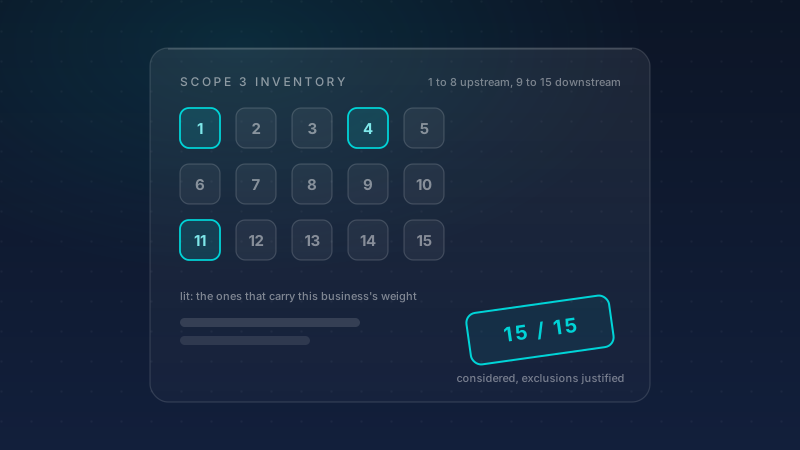
- All fifteen categories considered, with exclusions justified. The Scope 3 Standard requires companies to "account for all scope 3 emissions as defined in this standard and disclose and justify any exclusions". UK SRS S2 requires the same consideration. "Not applicable" with a one-line reason is acceptable. A category that is simply missing is not.
- A method per category. Supplier-specific, hybrid, average-data or spend-based for purchased goods; fuel-based, distance-based or spend-based for transport and travel. State which you used and why.
- A data hierarchy that moves up over time. Spend-based estimates are allowed for a first year, but UK SRS S2 says reporters "shall prioritise... the use of primary data", and the proposed GHG Protocol tiers would make the data type visible on the face of the report. Plan to replace spend with activity data, then supplier data, for the largest categories.
- The factor year. Name the dataset. The 2026 UK government factors were published on 11 June 2026 and revised on 31 July 2026, and the electricity factor fell 26% on 2025. Mixing years makes a trend meaningless.
- A base year and a recalculation policy. The SBTi's criteria set a 5% significance threshold for recalculating when boundaries or methods change. Even outside the SBTi, write down when you will restate.
- An audit trail. Every figure traceable to a bill, a meter, a journey log or a supplier statement. The FCA will require listed companies to say whether they obtained assurance; a customer may ask to see the workings.
The order matters. Businesses that start with the audit trail and the boundary find the categories fall into place. Businesses that start with a spend-based total and work backwards spend the second year rebuilding it.
How Dashe can help
The hardest practical requirement in that list is the audit trail, because scope 3 data is scattered across fuel cards, finance, telematics, travel bookings and people's own cars. Dashe connects to the systems a business already runs and converts the data to CO2e as it lands, with a per-journey, per-vehicle record behind the totals. Each vehicle carries its own emission factor from a DVLA or VIN lookup rather than a fleet average. For business travel and commuting, the categories PPN 006 requires and SECR partly requires, the Dashe app detects journeys in the background and records mode, distance and CO2e without forms. It was built to protect users' privacy and is GDPR compliant.
Reports export aligned to SECR and the GHG Protocol, with scope 1, 2 and 3 shown separately. Software does not decide which categories are material or guarantee compliance with any of the regimes above, and it will not write your exclusion justifications. It does mean that when the next tender or questionnaire asks for scope 3, the numbers already exist. See how Dashe supports scope 3 reporting.
Frequently asked questions
Do SMEs have to report scope 3 emissions in the UK?
Not by law. SECR applies only to quoted companies and to companies and LLPs meeting two of £36 million turnover, £18 million balance sheet and 250 employees. UK SRS is voluntary for unlisted companies. The obligation reaches smaller businesses through customers: a PPN 006 Carbon Reduction Plan if you bid for major government work, and supplier questionnaires from larger clients.
Which scope 3 categories does SECR require?
For large unquoted companies and LLPs, only business travel in hire or employee-owned vehicles where the company buys the fuel, which is part of category 6. Quoted companies have no mandatory scope 3 under SECR. Everything else is "voluntary, but strongly encouraged where this is a material source of emissions". The May 2026 review flagged this selective inclusion as a source of confusion.
What does "comply or explain" mean for scope 3?
Under the FCA's rules from 1 January 2027, a listed company either discloses its scope 3 emissions under UK SRS S2 or states which requirements it did not meet and why. For the first year a transitional relief allows scope 3 to be omitted on disclosure of the relief alone. The FCA chose this approach because "many issuers face challenges accessing the data needed".
Can I use spend-based data for scope 3 reporting?
Yes, and most first inventories do. The GHG Protocol's technical guidance lists the spend-based method as a recognised approach for purchased goods, transport and travel. It is the least accurate option, UK SRS S2 requires reporters to prioritise primary data where available, and the proposed GHG Protocol revision would show the data type in tiers. Treat spend-based figures as a starting point to improve on, not a destination.
Do scope 3 figures need to be assured?
Not under SECR or PPN 006, though a Carbon Reduction Plan must be director-approved. The FCA's rules will require listed companies to disclose "whether or not they have obtained third-party sustainability assurance" and, if so, the provider, the level and the standard used. Assurance is not mandated, but the question has to be answered, which in practice pushes companies towards it.
What happens if I exclude a scope 3 category?
Nothing, provided you say so and why. The Scope 3 Standard requires companies to "disclose and justify any exclusions", and UK SRS S2 requires disclosure of which categories are included. Under the proposed revision to the GHG Protocol, exclusions would be "capped at 5% of total required scope 3 emissions", so excluding a large category would no longer be an option for companies claiming conformance.
Conclusion
Scope 3 reporting in the UK is mandatory in pieces: one category under SECR, five under PPN 006, all fifteen on a comply-or-explain basis for listed companies from 2027, and whatever your customers' own reports need from you. The direction is consistent across every regime, including the EU and the voluntary standards: consider all fifteen categories, justify what you leave out, prioritise primary data and keep an audit trail. A business that builds its scope 3 report to that standard now will meet SECR's amended rules, a Carbon Reduction Plan and a customer questionnaire with the same data. The next step is to screen all fifteen categories and get the travel, transport and waste data flowing. Dashe can help with that part.
See Dashe in action
Book a demo and see how automated carbon data works for your business.
Book a demo